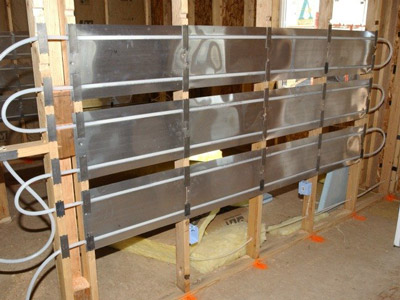




Radiant Heating & Cooling
Radiant: Floor, Walls, Ceiling, or Panels Provide Extreme Comfort, Ultra-Efficiency, Superior Indoor Air Quality
Why are people with radiant systems so happy with them?
The reasons include much better thermal comfort, better temperature stability, lower energy costs, and better IAQ (indoor air quality). And, radiant is silent, and draft-free. Here we will briefly explain the realities of radiant climate control with information for users, designers, contractors, and engineers.
NOTE THAT CHILTRIX DOES NOT DESIGN OR SELL THE INDOOR COMPONENTS OF A RADIANT SYSTEM. We leave that to the experts, it is a specialty. We can design and provide the world’s best and most efficient main system (heat pumps, buffer tank, domestic hot water, any fan coils if needed) – and provide a plug-and-play system for powering a radiant system, but a radiant supplier or contractor will be used for the radiant itself. Our goal on this page is to provide accurate information about radiant heating and cooling.
RADIANT
FACT CHECK:
1. Much Better Comfort.
TRUE. Silent, gentle radiant provides a more stable and vastly improved “feels like” temperature experience.
2. Improved Indoor Air Quality.
TRUE. Low indoor air velocity allows dust, mites, and other nasty things that “float” in the air to settle to the floor where they can be removed by a vacuum cleaner, mop, etc. Instead of being filtered by your lungs.
3. Higher Cost.
PARTLY TRUE. Radiant has a higher price than a conventional forced air system. In every area of life, the best stuff usually does have a higher initial price, and anyone who has it will tell you that radiant is the best thing ever and they would never give it up. The good news is that with a proper design, large efficiency gains can provide a lower total cost over a reasonable payback period.
4. Saves Energy.
TRUE. All other things being equal, as a matter of physics, a radiant system will be much more energy efficient. Firstly, a higher Carnot efficiency will be produced by the more efficient operating temperature. Secondly, water carries and delivers heat 3,500 times better than air.
5. Reduces the Load.
TRUE. A building heated or cooled via radiant “feels” around 5 °F warmer in the heating season and around 5 °F cooler in the summer, than the “real” temperature. This allows a lower temperature delta between indoors and outdoors, which reduces heat transfer (winter loss/summer gain) through the building envelope, providing additional off-the-books energy cost savings.
6. Slower Response Time.
PARTLY TRUE. Radiant can take a little longer to get started if the system is off. But a properly designed system will start itself at a low operating temperature and automatically increase as the load increases for seamless comfort without any delay. Also, proper system design can reduce thermal mass and improve response time.
7. Can Radiant “Over-Power” a net-zero or passive house home?
FALSE. This would be true only with a poor design. Radiant is a perfect solution for highly efficient homes, particularly those with HRV/ERV equipment, as radiant can allow a very high rate of fresh outside air ventilation, critical in a tight home, without suffering any loss of indoor comfort control. It’s actually the best way to handle a tight house along with an ERV or HRV.
8. Easier Path to “Net-Zero” Energy Bills.
TRUE. When using a hydronic heat pump and becoming all-electric, you have the option to self-produce free clean solar energy. Actually, going all-electric is the only path to net-zero, as there are no panels you can put on your roof that make gas, oil, or propane.
9. Radiant cooling Can Cause Condensation Problems.
PARTLY TRUE. A radiant system used for cooling must use a dew point controller to prevent unwanted condensation. See our ultra-simple high-reliability & accurate radiant cooling controller here.
10. Radiant Cooling Requires a Dehumidifier.
MOSTLY TRUE. Especially, if your home is in a humid region. But nearly all ventilation and air quality experts agree that sensible (thermometer) cooling should be decoupled from latent cooling (humidity control) for better comfort and energy efficiency regardless of the type of cooling system used. That’s because modern building codes and design are such that the cooling load is low, therefore well insulated energy efficient buildings cannot expect a cooling system to run enough hours each day for proper dehumidification in the first place. So for any energy efficient building, a separate dehumidification system is generally required, regardless if radiant cooling is used or not. Once you understand that, you can see why radiant cooling at least deserves an evaluation.
11. All Radiant Designs Follow the Same Basic Rules.
NOT TRUE. A radiant system designed for a boiler may not follow the same rules. With a heat pump, you will get the highest capacity and efficiency when the radiant design favors a lower temperature lift. For example, an efficient radiant design for a heat pump usually requires less than 100 °F operating temp for meeting the heating load, features PEX tubing where the tubing rows are closer together, with a designed temperature drop around 10 °F, along with an effort to reduce the total material (R-value) between the PEX and the room-facing radiant surface. Such a design benefits heating, and will likely result in a more favorable radiant cooling evaluation. You or your radiant designer can contact us with any questions.
About Radiant Cooling:
Radiant cooling may allow customers who install a radiant heating system a simple way to add cooling to their home with minimal additional hardware and labor cost, and without adding fan coil units, air handlers, ductwork, etc.
There is no form of cooling more comfortable or efficient than a properly designed radiant cooling system, however a careful evaluation must be made to verify that your radiant heating system, and cooling load, are compatible with radiant cooling. We are happy to help with that.
Radiant cooling (same effect as radiant heating) helps you gain extra comfort and efficiency, even in homes with high air changes, such as when using outside air ventilation or ERV (or, simply a leaky home). Due to the nature of radiant cooling & heating, a large volume of outdoor air can be brought in while maintaining indoor thermal comfort.
Radiant cooling will most likely require a dehumidifier at times of high humidity. A dehumidifier lowers the dew point, allowing a radiant cooling system to operate at a lower temperature thus having more cooling capacity, protects against EMC, mold, corrosion, and can make the home more comfortable. The operating cost of a dehumidifier can be more than offset by the large energy savings achievable with radiant cooling.
A special radiant controller (dew point controller) is used to prevent unwanted condensation.
Related Links
 CXRC1 Radiant Cooling Controller
 Radiant Indoor AIr Quality
Radiant Heating and Cooling Installation