



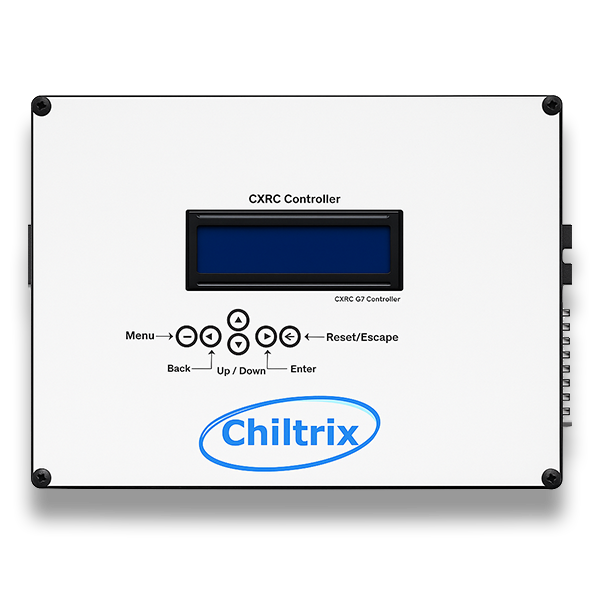
CXRC1
Radiant Cooling Controller
Product Description
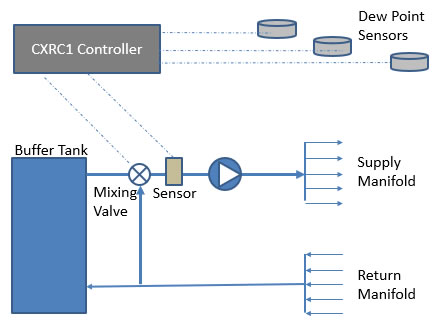
The CXRC1 radiant cooling controller continuously monitors up to (8) eight indoor dew point sensors and accurately modulates the water temperature feeding the radiant system to keep it close to, but above, the dew point. This prevents the problem of condensation forming on a radiant floor or radiant panel surfaces. Note: the CXRC1 is not a radiant controller. Rather, it is a radiant cooling controller add-on that can be added to and work with a standard radiant heating controller. It simply provides the additional functionality needed to perform radiant cooling without the problems of condensation. Sometimes called a Radiant Dew Point Controller
Advantages of the CXRC1 Radiant Dew Point Controller
The CXRC1 is a stand-alone radiant dew point controller that can work with nearly all radiant heating controllers. No need for a new radiant control system, just add the CXRC1. Works with Chiltrix or with any chilled water source to allow radiant cooling without condensation problems.Advantages, Disadvantages, Tips for Radiant Cooling in General:
Radiant cooling is the most efficient and comfortable cooling method available for customers in dry or moderate climates where it can be used as a complete cooling solution.
Radiant cooling is not an ideal primary cooling option for humid climates, but even in a humid climate it can be used to augment a forced air cooling system that is short on capacity, or to save money by performing a large percentage of the cooling as a higher efficiency. In wet climates, radiant cooling can be used along with fan coils or other cooling equipment, or with a dehumidifier, to carry part of the load, dramatically increasing the EER of the overall system.
Radiant cooling requires the addition of a special radiant cooling controller which modulates the temperature of the water entering the radiant system, to keep the radiant surface above the dew point, thus preventing unwanted condensation.
Indoor air quality is vastly superior with radiant cooling, compared to forced air cooling. That’s because dust, mites, and pollen no longer drift continuously on air and instead are allowed to fall to the floor by gravity where they are removed with the vacuum cleaner or other floor cleaning.
Have a room with a lot of south facing window glass? This makes the floor in that room a magnet (an absorber) for summertime radiant heating which then heats the room up as it emits the radiant energy it has absorbed. Such a room may “feel” hot even when the thermostat is satisfied. Radiant cooling in the floor of that room can eliminate or sharply mitigate such a problem, even in a humid climate.
Radiant cooling allows customers who already have radiant heating a fairly simple way to add cooling to their home with minimal additional hardware and labor cost without adding fan coil units, air handlers, ductwork, etc.
Radiant cooling (and heating) help you gain extra comfort and efficiency in homes with high air changes, such as when using outside air ventilation (or, simply a leaky home). Due to the nature of radiant cooling & heating, a vast amount of outdoor air can be brought in while maintaining comfortable indoor temperatures.
Radiant cooling and heating both work well from the ceiling, in fact both radiant heating and cooling can work better from the ceiling. This may go against 100 years of radiant “floor heating” folklore but as a matter of physics it’s clear that the ceiling works as well if not better. Radiant heating and cooling are the result of transmission and absorption/emittance of light (photons) at a wavelength called LWIR (long-wave infra red) that cannot be seen by the human eye. But it is still light. With that said, would you light a room from the floor? If you have radiant in the floor, that’s fine and a proven method. For new construction, consider radiant from the ceiling.
Radiant cooling may require a dehumidifier at times of high humidity. A dehumidifier removes humidity as needed to protect against EMC, mold, corrosion, and to make the home more comfortable – this process also lowers the dew point, allowing a radiant cooling system to operate at a lower temperature thus having more cooling capacity. While a dehumidifier may not need to operate frequently, in many climates it is desirable to have a dehumidifier since for example, rainy weather can cause a spike in humidity. In general, a small dehumidifier somewhat centrally located is all that’s needed.
Dew point sensors must be specified and ordered according to the following rules: 1) at least one per floor 2) at least one, centrally located, per each 1500 ft^2 of open space 3) at least one for any “closed off” area such as a bedroom (but not including closets or bathrooms, which should not use radiant cooling).
Radiant Heating Hardwood Floor Protection
An added bonus feature of CXRC1, it can limit the maximum heating temperature during the heating season. So if you want to use radiant heating with an engineered, laminated, or hardwood floor – and are required to limit the maximum temperature to protect the floor and/or the floor warranty – the CXRC1 can handle this for you.
How the CXRC1 Radiant Cooling Controller works:
Product Documentation, Specs, and Certifications
 CXRC1 Radiant Cooling Controller Spec Sheet
 Radiant Calculators
Everything included with the CXRC Radiant Controller:
- 1x CXRC1 Radiant Cooling Controller CPU w/ LCD screen
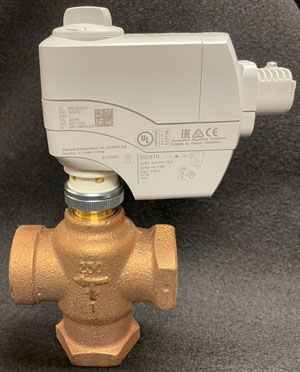
- 1x Siemens Radiant Cooling Mixing Valve w/ Fast Acting Actuator
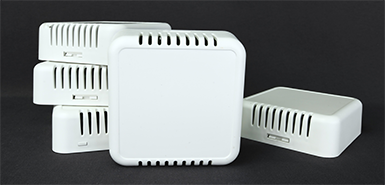
- Up to 8x Amphenol Dew Point Sensors Supported
- 1x Heraeus PT100 Fluid Temperature Sensor w/ Well
- 1x 24 V Power Supply
- 4-Port / 8-Port RJ45 Ethernet Jacks for Dew Point Sensors
- The CXRC1 system requires a 120 VAC power connection.
CXRC1 includes the following system components:
Radiant Cooling Mixing Valve
DPX1 Dew Point Sensor
CXRX1 Version 1.2 now supports maximum safe temperature control for radiant heated hardwood floors.
Protect your hardwood, laminate, or engineered floor, and your flooring warranty, with a 2nd layer of assured temperature protection.
Radiant heating can be used successfully with all wood floors such as laminated flooring, engineered wood flooring, LVT, PVC, vinyl planks, linoleum, bamboo, and of course natural solid wood flooring. That means that any flooring can be used with radiant heating as long as the temperature is controlled so as to not exceed the maximum allowed by the particular material. For example, guidelines provided by The National Wood Flooring Association (NWFA) Radiant Heat Taskforce provide maximum recommended allowable operating temperature guidelines for wood floors.
The guidelines were developed in response to recurring failures of hardwood floors placed over radiant floor heating systems. The maximum temperature allowed is specific to the manufacturer of the materials. The NWFA guidelines recommend the use of a temperature-limiting type of thermostat, in addition to the air temperature sensing portion of the typical thermostat and/or the temperature controls of a boiler or heat pump. The CXRC controller can provide that “second layer” of thermal management to protect your floor and your flooring warranty.