



Air-to-Water Heat Pump Manufacturer Chiltrix
Dynamic Outdoor Reset Control
Automatic Heating Reset Curve
All air-to-water heat pumps used in heating mode work more efficiently and have higher capacity when the heating loop operating temperature is lower, including the AHRI-Certified record-setting Chiltrix units. That’s because when the loop operating temperature is lower, there is less “lift” or delta between outdoor ambient and the loop operating temperature, resulting in less work for the compressor to do and this produces gains in both efficiency and capacity.
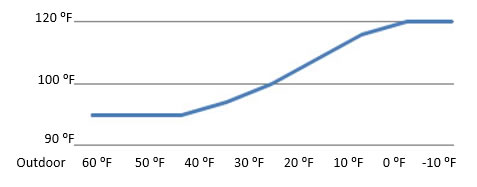
Accordingly, indoor equipment, fan coils, air handlers, or radiant installations, should be sized to run at the most efficient (coolest possible) heating temperature. A cooler heating supply temperature means you will use a slightly larger fan coil, air handler, or a more efficient radiant design.
As mentioned, with fan coils or air handlers, when using a lower operating temperature, just use a larger size unit. Chiltrix fan coil units and air handlers are already rated to deliver performance at low operating temperatures. For radiant systems, using a lower loop temperature means a design using more PEX, or larger panels, better design, etc.
A highly efficient radiant floor system might be designed to handle the design heating load at a 95 °F loop operating temperature. But for some buildings in certain climates, at design-day conditions the loop either may need to be warmer than that to have higher capacity. A lower temperature radiant design for heating is always the better choice for COP and this may mean closer PEX spacing, or even adding some PEX in walls, or ceiling.
From an efficiency or capacity standpoint, increasing the indoor load handling capacity is vastly preferable to increasing the operating temperature of an air-to-water heat pump.
However, in some cases the only option is to raise the operating temperature when it gets colder outdoors. But the higher temperature is needed only on those days, not all the time. And even when a system is designed to meet the coldest-day design heating load at a low operating temperature, why not take advantage of an *even lower* temperature on a mild day? These are the areas where “outdoor reset” can be beneficial.
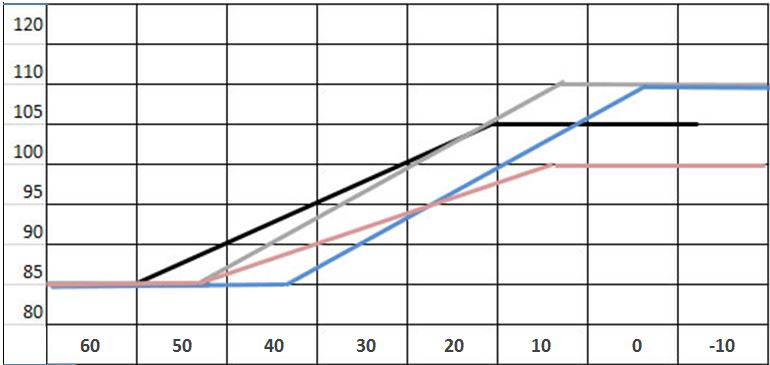
Programmable Dynamic Outdoor Reset Curve For Maximum Efficiency!
Note the “orange” curve above. In this example the loop operating setpoint will be 100 °F when outdoor temperature is at or below 5 °F outdoor temp. But on a milder heating day of 53 °F, the loop setpoint will be around 85 °F, saving a large amount of energy used per BTU/h of heating compared to simply setting it at 100 °F all of the time. The dynamic outdoor reset control of the Chiltrix system will proportionally adjust its operating temperature according to the outdoor temperature.
As outdoor temperature falls, the loop operating temperature is automatically increased. As outdoor temperature rises, operating temperatures are automatically decreased. The orange curve is designed for extra energy savings on milder days. This, or any of the above curves, can also be used to work around indoor-side design limitations.
The other curves shown are not necessarily valid or recommended and are only presented as examples. Once you create and input your curve, it will work automatically and adjust the temperature in 1 °C increments. And it is easily configurable so you can tweak it to be perfect for your application.
Product Documentation, Specs, and Certifications
 Dynamic Outdoor Reset Curve Tool - Gen3 Current Version (Click for Download)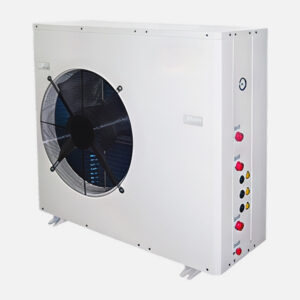
Advantages & Misconceptions of Using Outdoor Reset
Most people in the radiant heating industry will tell you that outdoor reset is used to get more BTU/h delivery from the radiant system on a day when the radiant system can’t deliver enough BTU/hs to keep up with the load, and they use outdoor reset to crank up the radiant heat operating temperature to 120 °F, or higher.
While that’s true, it’s also true that the best designed air-to-water radiant systems will be able to deliver what’s needed at a fairly low temperature even with severe outdoor design conditions.
So if you can’t get enough radiant capacity into the floor, then if possible, add some to the walls or ceiling. Note that radiant heat works just as well from the ceiling or walls as it does from a floor. And in some cases, it works better from the ceiling.
Why does keeping the operating temperature low matter so much?
With a fossil fuel burning boiler, it doesn’t matter. Gas, propane, and oil efficiency does not vary with outdoor temperature or the amount of lift. But that’s not the case with a heat pump.
Here’s why:
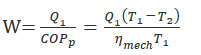
For a real-world example, at 0 °F outdoor temperature, an air-to-water heat pump will have ~20% higher capacity when used with an operating temperature of 95 °F compared to operating at 122 °F. And COP at 95 °F will be ~30% higher at 95 °F than at 122F.
Why use dynamic outdoor reset?
The best use of dynamic reset is as a strategy for extra energy savings, by designing the indoor side of the system to handle the peak load at the lowest possible operating temperature, and then letting the system automatically reset to an even lower and more efficient temperature (less lift) at times when weather is milder.